
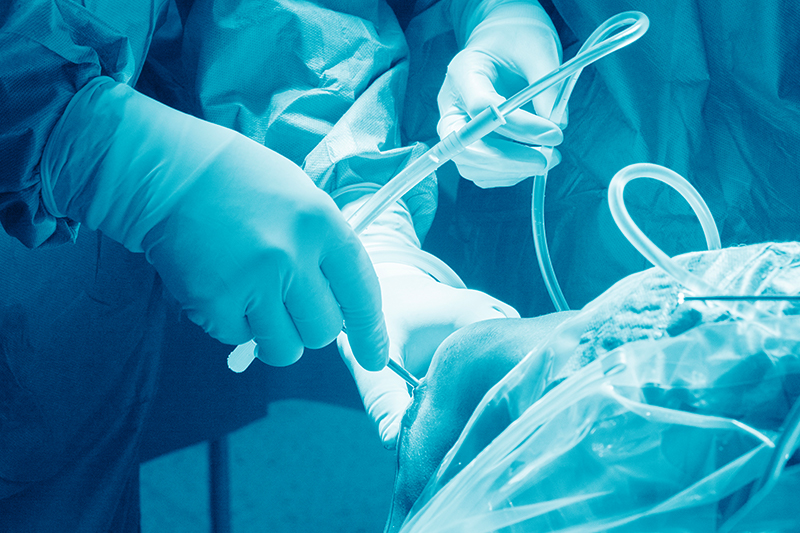
Learn more about arthroscopy, a minimally invasive operation to repair a damaged joint
Arthroscopic surgery is a revolution in orthopedics, and it has changed the way we operate on joints. This minimally invasive procedure has given us the power to accurately examine joints from the inside, making a diagnosis with 100 percent accuracy. Not even an X-ray, CT scan or MRI can provide such results—with arthroscopy, you can see everything clearly and sometimes even fix the problem immediately.
Arthroscopy is where you make a very tiny incision in the skin around a joint—such as the knee or elbow—and insert a thin fiberoptic scope. This simple device gives us a very clear view of the anatomy of the joint—the cartilage, the meniscus, and all the minute structures between the bones. If there is damage, it’s usually quite apparent, and if (for example) you need to repair the damage or remove some tissue, you can cut another tiny hole and insert a separate instrument inside to do the job.
The science of arthroscopy has come a very long way. In the beginning, the procedure was really only used as a diagnostic tool. With the development of new techniques, materials, instruments and tools for treatment, we have learned to use arthroscopy to treat many disorders—especially soft tissue disorders like cartilage tears, meniscal tears, ligament ruptures and damage to other anatomical structures.
A good example is a torn meniscus, which is a very common sports injury. It’s a stretchable fibrocartilage within the knee that can easily rip with vigorous activity. 20 years ago, a meniscus tear was treated with open surgery—a surgeon would open the knee using a five or six-inch incision to get inside the joint and remove the part that was damaged.
With arthroscopy, we approach the same procedure with a very, very small incision. Whereas previously we may have just removed the part that was damaged, with the development of new arthroscopic techniques we can now try to repair the tear with a suture, pulling it together and allowing it to heal.
During my work as an orthopedic surgeon, I have focused my interest on arthroscopy of shoulder and knee and I have seen just how far the technique has come and what it has allowed us to achieve in our practice.
I started my training in Perugia, Italy under the supervision of Dr. Giuliano Cerulli, one of Europe’s most respected and highly regarded surgeons. In the early stages, as most practitioners often do, I had the opportunity to learn techniques and practice on cadavers while visiting cadaver labs once or twice a year.
After my specialization, I focused my training in arthroscopic surgery of the knee at the Aberdeen Royal Infirmary Hospital, Scotland and soon after, in Spain. Thanks to the supervision of senior consultants, I developed an interest in arthroscopy of the shoulder. From the start, I was impressed with how this mini-invasive surgery was able to resolve serious issues such as recurrent dislocation of the shoulder.
Regarding this pathology, I clearly remember my first successful case in which, via this arthroscopic technique, I was able to resolve a complex case involving a young man, whose quality of life was severely affected by episodes of recurrent shoulder dislocation. Under this mini-invasive procedure, soft tissue (labrum) damage was repaired, thereby fixing a problem that in most cases requires open and aggressive surgery.
Arthroscopic surgery has an important role in the treatment of injuries to athletes. It has a significant role in the surgical treatment of ligament injuries, such as anterior cruciate ligament reconstruction; and the surgical repair of tendon tear, such as rotatory cuff tear.
I believe that Vietnam’s very young population is gradually becoming more and more involved and interested in practicing sports; therefore we will be seeing an increase in sport injuries for which arthroscopic surgery will have a larger role in treatment.
It’s important to recognize that surgery is not always 100% successful, and even if it is a very low risk procedure, it is no different for arthroscopic surgery. We must keep in mind that even if they are rare, it is still a surgical procedure subject to complications. I also think that surgery should not always be the first choice, which is the reason why I always try to present an alternative option for patients, so as to give them the chance to explore forms of conservative treatment.
In conclusion, arthroscopic surgery is a procedure that offers great advantages to patients, and can often resolve or improve joint conditions, but it requires specific and extensive training from the orthopedic surgeon.