
“People believed that in order to get ahead in life, you had to speak the majority language.” - Simon Ager
Languages are the roots of our culture, we should embrace its beauty, its diversity, and its uniqueness; but sadly this is no longer the case. Globalization has caused major changes to the world’s cultural diversity. In this ever-evolving world, people are striving towards learning and speaking the languages that the majority speaks, overlooking the importance of preserving their mother tongues. Vietnam, with its 54 languages spoken by their respective ethnic groups, is no exception.
Globalization has resulted in the increased mobility of people and information, making communication a crucial part of our lives. However, this is the driving force to Vietnam’s emerging trend of culture conformity that is very much driving the diversity and distinctiveness of our 54 ethnic languages to the edge of their extinction.
Look to your right: Is it an iPhone or a Samsung that you’re seeing? Now, think of your favorite clothing brand that, my friend, is globalization. Globalization has made its way into our life without our awareness but, most importantly, we are conditioned to its presence. “Isn’t it better this way?” is what you might have thought. Well, first of all, the internet has assisted the mobility of information and empowered innovations regardless of where you are in the world. Multinational corporations are what drives the Vietnamese economy and enriches the market. However, little does everybody know what we welcome is killing our proud heritage and it is doing it fast, starting from our Vietnamese languages.
The globalized Vietnamese market welcomes foreign investments; consequently the urban areas are under its direct influence and therefore rapid economic growth is inevitable. The distribution of growth is uneven as seen with the rural areas experiencing job losses as well as labor relocation to cities. The phenomenon raises the importance of speaking the ‘majority’ language: Kinh, known as the official Vietnamese language. Statistics collected in 2009 showed that Kinh speakers made up 86 percent of the population, followed up by the Tay with 1.9 percent, Thai 1.7 percent, Muong 1.5 percent, Khmer 1.4 percent, and others 7.5 percent (mostly Chinese).
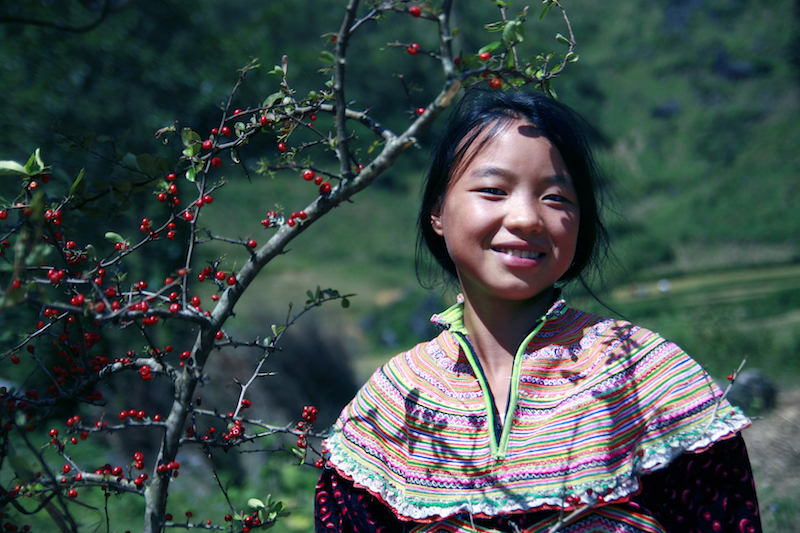
‘’Today, H’mong people only want to move to the cities to have more job opportunities and a better life quality. This also means that they have to learn Kinh,’’ says Mrs. Giang Thi Dinh. She is a mother of three living in the isolated mountain regions of Sapa. At a young age, Mrs. Dinh was one of the few villagers to quickly recognize the importance of learning the ‘majority’ language and was soon rewarded with an opportunity as a tour guide in her hometown. She has been working for seven years; this however is not the case for those did not receive an education in Kinh. Nowadays, primary schools in the village have instructors lecturing in this ‘majority’ language because the H’mongs believe that their mother tongue should only be spoken within the family.
Urbanization is another undeniable and apparent contributing factor of globalization, causing the minority languages endangerment. ‘’Vietnam is rapidly urbanizing. The urbanization process will be an important part of Vietnam’s future; ensuring livable cities can compete regionally and globally will be necessary to the Vietnam’s economic development strategy,’’ said Victoria Kwakwa, Country Director for the World Bank in Vietnam.
Dak Lak, a province located in the Central Highlands of Vietnam and home to many indigenous people, is recorded to have shown a quick progress of urbanization. In 2004, Dak Lak has 13 cities but after six years, the number has increased to 16. Many homes of the six existing ethnic groups in the area are urbanized to help the growth of the economy. Consequently, their cultures and languages are shifted to conform to the environment they are put into.
After being alarmed with the effects, let’s rethink the question that lies within our conscience: ‘’Is it really better this way?’’ My answer is no. Sure, globalization has brought countless beneficial results to Vietnam but its negative influences on our distinctive culture aren’t being recognized. Younger generations of the ethnic minorities are slowly losing their roots and being blinded with the belief of speaking the ‘majority’ language. Despite this, no action has been taken towards the issue. We stress the importance of saving endangered species to maintain the agricultural and ecological values, yet why are our attention lacking on endangered languages? Languages shape our cultural identity and without languages of our own, uniformity will be present and therefore take away the beauty in our individuality. The government must seek a solution to preserve the diversity in the Vietnamese culture and enforce a law for local schools to teach students in their mother tongue.
In the near future, we are hoping to see more than just 30 ethnic groups having a voice in their own languages amongst the 54 existing groups.
A recent graduate of ISHCMC, Jasmine wrote this opinion piece while she was in 11th grade for her English class. The topic of minority languages appealed to her after a trip to Sapa four years ago when she explored the diverse cultures that exist within the region. A recent return visit to Sapa shocked Jasmine because the province has turned into a tourist attraction, become more commercialized and lost its distinctiveness. She wrote the article to raise awareness of how globalization has negatively impacted her homeland— Vietnam’s economical growth is important but so are its roots and cultural heritage.
Image by Ngoc Tran